The Weight of This Decision
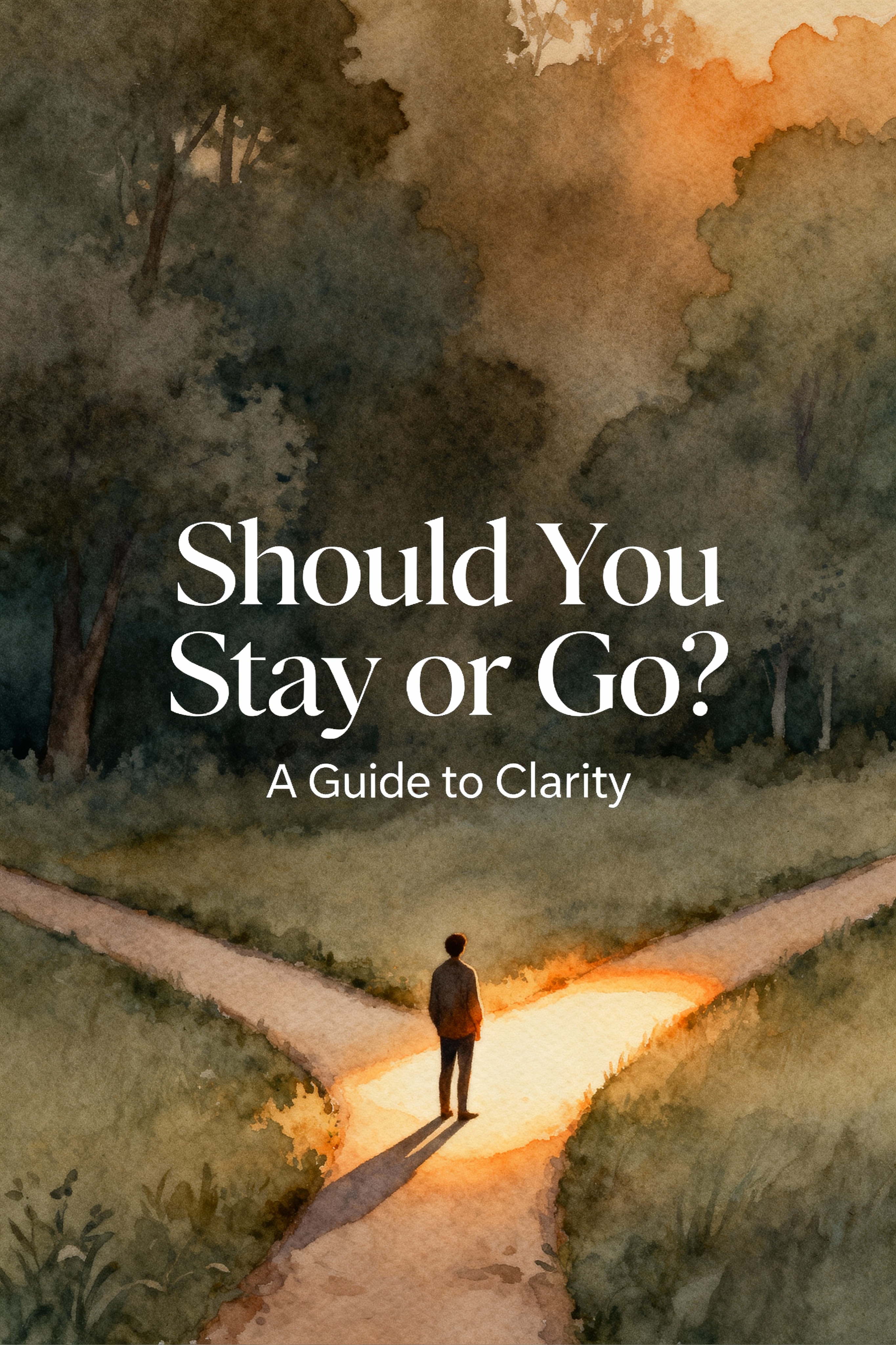
If you're reading this, you're likely facing one of the most difficult questions anyone can ask themselves: Should I stay in this relationship, or should I go?
This isn't a decision to take lightly. It's not about a bad week or a single fight. You're here because something fundamental feels uncertain, and that uncertainty has been living with you for longer than you'd like to admit.
First, let me say this: The fact that you're asking the question doesn't mean your relationship is doomed. Many couples face this crossroads and emerge stronger. But it also doesn't mean you should stay. Some relationships have run their course, and recognizing that takes courage, not failure.
What matters most right now is that you approach this decision with clarity, honesty, and compassion—for yourself and for your partner.
This guide will help you navigate this difficult terrain. We'll explore the signs that suggest a relationship can be repaired, the signs that it might be time to leave, and most importantly, how to distinguish between fear and wisdom in your decision-making process.
Signs the Relationship Can Be Repaired
Not every struggling relationship is a failing relationship. Here are signs that suggest your relationship has the foundation to rebuild:
You Both Want to Fix It
The most important indicator is mutual desire. If both of you are willing to acknowledge problems and commit to working on them, that's a powerful starting point. One person can't save a relationship alone, but two people who want to try have a real chance.
The Core Foundation Is Still Strong
Do you still respect each other, even when you're angry? Can you remember why you fell in love? If there's still affection, friendship, and fundamental respect beneath the current problems, that foundation can support the work of rebuilding.
The Problems Are Specific and Addressable
Some problems have solutions. Poor communication can be learned. Different conflict styles can be negotiated. Sexual disconnection can be addressed. Unbalanced responsibilities can be redistributed. If your problems are specific rather than pervasive, there's hope.
You Can Imagine a Better Future Together
Can you envision what a healthy version of your relationship would look like? If you can see a path forward—even if it's unclear how to get there—that vision matters. It means you haven't given up on possibility.
Both Partners Take Responsibility
In healthy relationships, both people can acknowledge their part in problems. If you can both say "I know I contributed to this" without keeping score of who's more at fault, you're showing the maturity needed for repair.
There's Still Curiosity About Each Other
Do you still wonder what your partner is thinking? Are you interested in their day, their dreams, their fears? Indifference is harder to overcome than conflict. Curiosity suggests the emotional connection isn't severed.
You're Willing to Get Help
If both of you are open to counseling, reading books, attending workshops, or doing whatever it takes, that willingness is itself a sign of hope. Pride kills relationships; humility saves them.
Signs It Might Be Time to Leave
Sometimes love isn't enough. Here are signs that suggest leaving might be the healthier choice:
One Person Has Checked Out
If your partner has clearly disengaged—emotionally, physically, or both—and shows no interest in reconnecting, you can't force someone to want to stay. A relationship requires two active participants.
The Same Patterns Repeat Despite Efforts
Have you tried to fix things before? Have you been in counseling, had serious conversations, made promises and plans? If the same destructive patterns keep emerging despite genuine efforts to change, the relationship itself might be the problem.
You've Lost Yourself
Healthy relationships help you become more yourself, not less. If you find yourself constantly walking on eggshells, suppressing your thoughts and feelings, or can't remember who you were before this relationship, that's a serious red flag.
There's Contempt and Disrespect
Relationship researcher John Gottman identifies contempt as the strongest predictor of divorce. If there's name-calling, mockery, eye-rolling, or a general attitude that your partner is beneath you (or you beneath them), the relationship is in serious danger.
Your Values Are Fundamentally Incompatible
Do you want children and they don't? Do you have deeply conflicting views on religion, money, or lifestyle? Some differences can be negotiated; others are dealbreakers. If your visions for life are fundamentally opposed, staying together means one of you sacrificing something essential.
The Relationship Consistently Makes You Feel Worse
Pay attention to how you feel. Do you feel smaller, sadder, more anxious when you're together? Does the thought of going home fill you with dread? Your emotional experience is data worth listening to.
Trust Is Irreparably Broken
If there's been infidelity or betrayal and the person shows no remorse, continues lying, or you simply cannot imagine ever trusting them again despite their efforts, that broken trust may be unfixable.
You're Staying for the Wrong Reasons
Fear of being alone, financial dependence, concern about what others will think, or hoping they'll change "if you just love them enough"—these aren't good enough reasons to stay in an unhappy relationship.
The Deal-Breakers: When You Must Leave
Some situations aren't about "should I stay or go?" They're about safety and survival. Let me be absolutely clear:
Physical Abuse
If your partner has hit, pushed, restrained, or physically harmed you in any way, that is a dealbreaker. It doesn't matter if they apologized, if they were drunk, if it only happened once. Physical violence is never acceptable, and it typically escalates.
Please reach out to the National Domestic Violence Hotline (1-800-799-7233) or visit thehotline.org for support and resources.
Emotional Abuse
Abuse isn't always physical. Emotional abuse includes:
- Constant criticism and humiliation
- Isolating you from friends and family
- Controlling your finances, movements, or decisions
- Threatening you or your loved ones
- Gaslighting (making you question your reality)
- Destroying your property or hurting pets
This is also a dealbreaker. Emotional abuse damages you profoundly, and it rarely improves without the abuser acknowledging the problem and getting serious help—which most don't.
Active Addiction Paired with Refusal to Get Help
If your partner struggles with addiction and refuses to acknowledge the problem or seek treatment, you cannot fix them, and staying often enables the addiction. Your presence won't save them, but it might destroy you.
Repeated Infidelity Without Remorse
One instance of infidelity can potentially be worked through if there's genuine remorse and commitment to rebuilding trust. But if your partner has cheated multiple times, shows no real remorse, or continues contact with affair partners, they're showing you who they are. Believe them.
If you are in any of these situations, please prioritize your safety. Leaving an abusive relationship is the most dangerous time—do it with support and a safety plan. You deserve to be safe, respected, and valued.
Questions to Ask Yourself
As you navigate this decision, spend time with these questions. Journal about them. Sit with them. Don't rush to answer.
About Your Relationship
- If nothing changed, could I be happy in this relationship five years from now?
- Am I staying because I love who they are, or who I hope they'll become?
- Do I feel like I can be myself in this relationship?
- Are we partners who face life together, or opponents who fight each other?
- What would I tell my best friend if they described this relationship to me?
About Yourself
- Am I willing to do the hard work of repairing this relationship?
- What am I afraid will happen if I leave?
- What am I afraid will happen if I stay?
- Am I making this decision from fear or from wisdom?
- Have I grown or shrunk in this relationship?
About Your Partner
- Does my partner take responsibility for their actions?
- Do they show consistent effort to change, or just promises?
- Does my partner support my growth and happiness?
- Can my partner acknowledge my pain without becoming defensive?
- Do I trust my partner's character, even when I'm upset with their behavior?
About the Future
- Can I envision a happy future with this person?
- What would need to change for me to feel hopeful again?
- Are those changes realistic and within my partner's capability?
- If we have (or want) children, is this the relationship I want to model for them?
- Will I regret staying? Will I regret leaving?
The "All-In" Test
Here's a powerful exercise that cuts through ambivalence:
Imagine committing fully to making this relationship work for the next six months. Not half-heartedly, not keeping one foot out the door, but truly all-in. You'd go to counseling, read books, have hard conversations, be vulnerable, try new things, and give it everything you have.
Now notice: How does that feel in your body?
Do you feel relief? A sense of hope or purpose? That might indicate you want to stay but have been afraid to fully commit.
Or do you feel dread? Exhaustion? Resentment at the thought? That physical response is information. Your body often knows before your mind does.
Now imagine the opposite: deciding to leave and starting the process of separating your lives.
How does that feel?
Grief and fear are normal—even necessary emotions when ending a relationship. But underneath those, is there a sense of relief? Of possibility? Of breathing room?
Or is there panic, regret, a feeling of making a terrible mistake?
Neither response is wrong. Both are information about what you truly want.
When Ambivalence Is the Problem
Sometimes the issue isn't that the relationship is terrible—it's that you can't decide. You swing back and forth. Some days you're sure you need to leave; other days you can't imagine it.
This chronic ambivalence is itself a problem, and it often signals:
Fear of Commitment
If ambivalence has been present from the beginning, you might struggle with commitment in general. This isn't about this relationship—it's about you. Therapy can help you understand whether you're avoiding intimacy or genuinely with the wrong person.
Avoiding Grief
Sometimes we stay ambivalent because both options involve pain. Staying means accepting the relationship as it is; leaving means grief and loss. Ambivalence lets us avoid both. But this middle ground is often more painful than either choice.
Waiting for Certainty That Won't Come
You might be waiting for absolute certainty before deciding. But that level of certainty rarely exists in matters of the heart. At some point, you have to make a choice with incomplete information and trust yourself to handle what comes.
Unresolved Trauma
If you experienced abandonment, neglect, or inconsistent love in childhood, you might recreate that pattern through ambivalence. Part of you wants to leave (recreating abandonment); part of you desperately wants to stay (seeking the security you never had).
If ambivalence has been your dominant experience for months or years, it might be time to make a decision—any decision—and stop torturing yourself and your partner with uncertainty.
Separating Fear from Wisdom
The hardest part of this decision is distinguishing between fear and intuition. Both can tell you to stay or go, but from very different places.
Fear Says:
- "I'll never find anyone else"
- "I'm too old/damaged/complicated to start over"
- "Everyone will judge me"
- "What if I'm making a mistake?"
- "I can't handle being alone"
- "The unknown is too scary"
Wisdom Says:
- "This isn't healthy for either of us"
- "I've tried everything I can think of"
- "I deserve to feel valued and respected"
- "Staying is teaching my children unhealthy relationship patterns"
- "I can handle hard things, including this"
- "Short-term pain might lead to long-term peace"
Fear is focused on avoiding discomfort. Wisdom is focused on long-term wellbeing, even when it's painful.
Fear keeps you frozen. Wisdom moves you forward, even when the path is unclear.
Ask yourself: Is this fear talking, or is this wisdom?
Making the Decision: The Process
When you're ready to decide, here's a process that can help:
Step 1: Get Clear on Reality
Write down the facts of your relationship without interpretation. Not "they don't care about me" but "they work late most nights and don't ask about my day." Facts give you something concrete to work with.
Step 2: Name What You Need
What would need to change for you to feel good about staying? Be specific. "Better communication" is vague. "Weekly check-ins where we each share something vulnerable and really listen" is specific.
Step 3: Assess Capacity for Change
Are the changes you need realistic? Are they things your partner can actually do? Have they shown willingness to try? One person can't change another, but they can change themselves and the dynamic might shift.
Step 4: Set a Timeline
Chronic indecision is its own form of torture. Give yourself a timeline. "I will work on this relationship with full effort until date, and then I'll reassess." Knowing you have an end to the uncertainty can help you be more present.
Step 5: Trust Yourself
You know more than you think you do. If you've been in this relationship for years, you know your partner. You know the patterns. You know what's changed and what hasn't. Trust that knowledge.
Step 6: Make the Decision
Eventually, you have to choose. Not perfectly, not with complete certainty, but with the information you have and trust in your ability to handle what comes next.
If You Decide to Stay: Next Steps
Choosing to stay isn't the easy way out—it's committing to the hard work of rebuilding. Here's how to move forward:
Make It a Real Decision
Tell your partner: "I'm choosing to stay, and I'm choosing to work on this relationship." Not "I guess I'll stay" or "I'm too scared to leave." A real commitment.
Get Professional Help
Find a couples therapist. Not someone to validate your position, but someone who will challenge both of you and provide tools for change. Individual therapy can also help each of you address your own patterns.
Define What Success Looks Like
Together, get specific about what needs to change. Create a shared vision of what you're working toward. Vague hopes won't sustain you through the hard work ahead.
Establish Clear Boundaries
What behaviors are no longer acceptable? What happens if those boundaries are crossed? Boundaries aren't threats—they're clarity about what you need to feel safe and respected.
Create New Patterns
You can't fix old patterns by having the same fights in the same ways. Try new approaches. Attend workshops. Read books together. Practice skills you've never had.
Track Progress
Check in regularly—monthly or quarterly. Is the relationship moving in the direction you hoped? Are you both still committed? Staying doesn't mean staying forever if nothing changes.
Take Care of Yourself
Working on a relationship is draining. Make sure you're still nurturing yourself, maintaining friendships, and finding joy outside the relationship. You can't pour from an empty cup.
If You Decide to Go: Next Steps
Choosing to leave is heartbreaking even when it's right. Here's how to move through it:
Make a Plan
Leaving safely and practically requires planning. Where will you live? How will finances work? If you share children, what's the custody arrangement? If you're in an abusive situation, make a safety plan before announcing your decision.
Tell Your Partner Clearly
When you're ready, communicate your decision with clarity and compassion. Not "maybe we should take a break" if you mean "this is over." Ambiguity causes more pain.
Get Support
Tell trusted friends or family. Consider therapy to process the grief and navigate the transition. Join a support group. You don't have to do this alone.
Allow Yourself to Grieve
Even if leaving is the right decision, you'll grieve. The relationship you hoped for. The future you imagined. The person you thought they were. Let yourself feel it all.
Resist the Urge to Go Back
After the initial decision, you'll likely have moments of doubt, especially when loneliness hits. Write yourself a letter now explaining why you're leaving. Read it when you're tempted to return.
Establish No Contact (If Possible)
If you don't share children or business, consider a period of no contact to heal. Staying in constant communication prevents both of you from moving forward.
Rediscover Yourself
Who were you before this relationship? What did you love? What do you want now? This is your chance to rebuild your life intentionally, not just react to loss.
Be Patient with the Process
Healing isn't linear. Some days will be good; others will hurt intensely. That's normal. Trust that eventually, the hard days will become less frequent.
Getting Professional Support
You don't have to figure this out alone. Professional support can make all the difference:
Couples Therapy
A good couples therapist can help you:
- Communicate more effectively
- Understand destructive patterns
- Navigate conflict constructively
- Decide if the relationship is salvageable
- Create a plan for moving forward (together or apart)
Look for therapists trained in evidence-based approaches like Emotionally Focused Therapy (EFT) or Gottman Method.
Individual Therapy
Even if you're doing couples work, individual therapy helps you:
- Understand your own patterns and needs
- Process your emotions
- Make decisions aligned with your values
- Heal from any trauma or attachment wounds
- Build the life you want, regardless of relationship status
Support Groups
Sometimes talking with others facing similar struggles helps you feel less alone. Look for:
- Divorce support groups (if you're leaving)
- Relationship support groups
- Co-dependents Anonymous (if codependency is a pattern)
- Al-Anon (if addiction is involved)
Crisis Resources
If you're in immediate danger or crisis:
- National Domestic Violence Hotline: 1-800-799-7233
- National Suicide Prevention Lifeline: 988
- Crisis Text Line: Text HOME to 741741
You Deserve Clarity and Peace
Whether you stay or go, you deserve to move forward with clarity, not remain trapped in chronic uncertainty.
You deserve a relationship where you feel valued, respected, and cherished—or the freedom to create a life where you can find that.
You deserve to make this decision based on wisdom, not fear.
You deserve support as you navigate this difficult terrain.
If you're in crisis in your relationship and need more support right now, explore our Crisis Guide for immediate help, resources, and a path forward. You don't have to do this alone.
Whatever you decide, trust that you have the strength to handle what comes next. You've already shown tremendous courage by asking the hard questions. That same courage will carry you through.